Clock a pitchwith your iPhone

Film a pitch or a swing in 240 fps slow motion. VeloVision measures it on the phone and replays it in a 3D stadium.

Get notified when it launches

In development, not released yet. No App Store link yet.
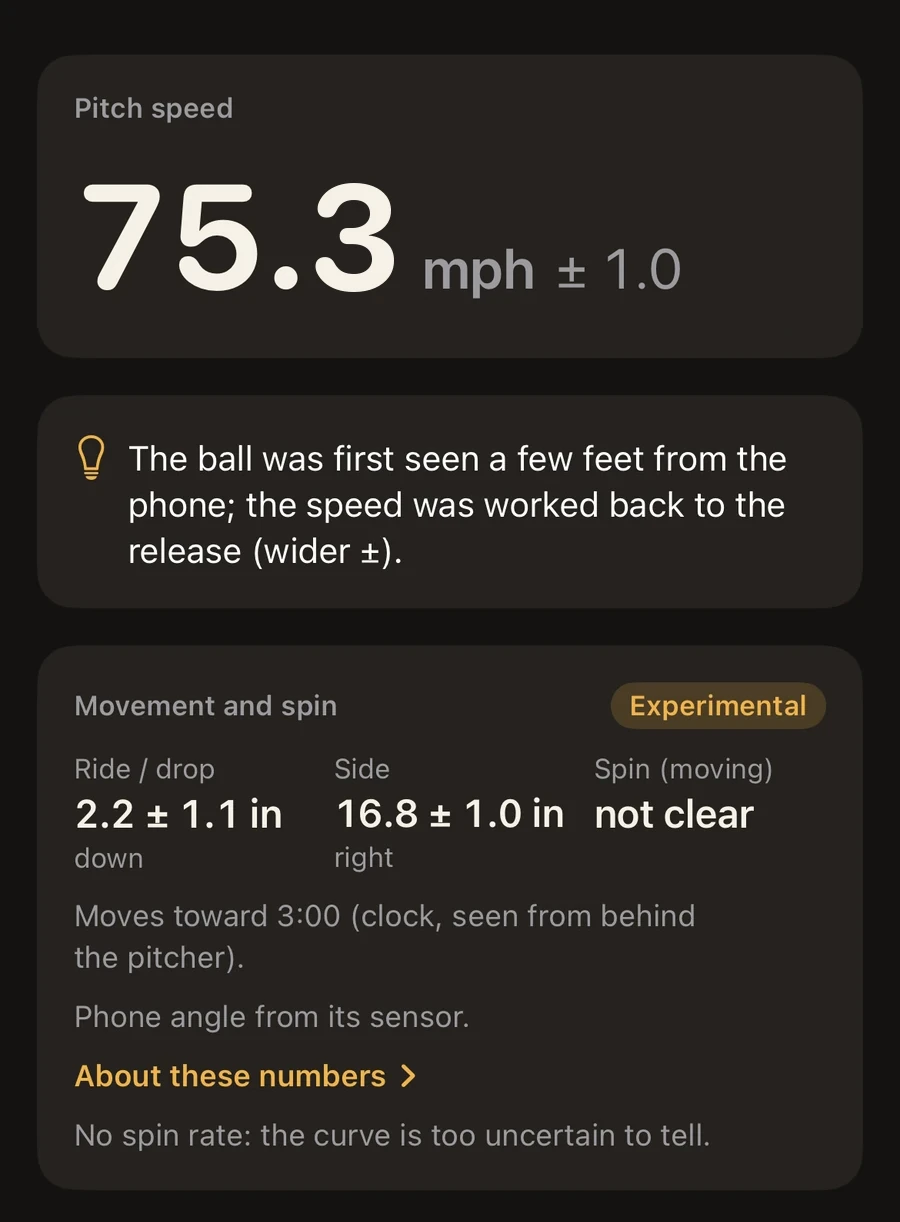
VeloVision result screen: pitch speed 75.0 mph plus or minus 1.0 with a Watch it in the stadium button, a tip that the ball was first seen a few feet from the phone, and the Movement and spin card marked Experimental
VeloVision result screen: 42.9 mph plus or minus 3.5 with an Estimate label, and two tips: speed is from where the ball first cleared the hand, and no distance was measured, so a measured distance is more reliable
VeloVision result screen reading No speed in red: no reliable speed, keep the whole flight in view and nothing in front of the phone
VeloVision Spin card marked Experimental: total spin 1,770 ± 150 rpm, active spin 1,510 ± 140 rpm, efficiency 85 ± 4 percent, gyro angle 31 ± 4 degrees clockwise, spin direction 2:30, and a seam-shifted wake of 18 ± 6 degrees
VeloVision Release and approach card marked Experimental: release height 5.1 ± 0.2 feet, release angle 0.8 ± 0.4 degrees up and 1.8 ± 0.2 left, arrival angle 6.8 ± 0.5 degrees down and 1.9 ± 0.3 right
VeloVision swing result marked Experimental: exit velocity 67.7 mph ± 3.2, launch angle 16.4 degrees ± 0.3, distance 185 feet ± 18
The app’s 3D stadium replay of a pitch from the TV camera: the ball and its trail arriving at the batter’s strike zone, with a readout bar: pitch speed 75.0 mph ± 1.0, zone, release height and approach angle
VeloVision history screen for one day: top 79.4 and average 62.8 mph, best exit velocity 80.1 mph, and nine saved results including pitch speeds with their ±, two swings with launch angle and distance, an Estimate and a No speed

75.0 mph ± 1.0The range is part of the answer. Under it, the movement card: ride or drop and side movement, marked Experimental.

EstimateNo distance entered, so the speed is labeled Estimate and the ± is wider. Enter the lens-to-net distance and it becomes more reliable.

No speedWhen it can’t measure reliably it says so and says why, for example “Keep the whole flight in view”. It refuses rather than guess.

Spin from the seams, ExperimentalTotal and active spin, efficiency, gyro angle and direction, each with its ±. When the seams fit two spins equally well, it shows none. Not yet checked against a spin-measuring device.

Release and arrival, ExperimentalRelease height, release angle and the angle the ball arrives at the net, each with its ±.

Swing, ExperimentalExit velocity, launch angle and distance from a swing filmed from beside the hitter, each with its ±.

3D stadiumReplay a pitch from the TV, Ball, Overhead, Side, Catcher or Zone view, or a swing from the TV, Ball, Overhead or Side view.

By dayEvery pitch and swing in a list, with the day’s top and average speed and best exit velocity at the head.

Behind the pitcher

  1. 5–7 feet back

    First, put the phone on a tripod behind the pitcher’s rubber, about 6 feet to the glove side and 4–5 feet high, aimed at the net. For a swing, beside the hitter.

  2. One tap

    Then tap the net on the screen to lock focus and brightness.

  3. 240 frames a second

    Next, film a pitch or a swing at 240 fps slow motion.

  4. On the phone

    Last, the app finds the ball in every frame, fits its flight and shows the numbers.

Enter the distance from the lens to the net for a more reliable speed; skip it and you still get a speed, labeled Estimate. For a swing, set the tripod 12–20 ft from the hitter, waist or chest high.

VeloVision Movement and spin card marked Experimental: ride 14.8 ± 1.0 inches up, side 2.0 ± 1.0 left, spin about 1,520 rpm, likely 1,000 to 2,630 rpm, moving toward 11:30; the top of the Spin card is below it
Movement and spinRide or drop and side movement, with spin. Experimental.
VeloVision Movement card and a Spin card marked Experimental that reads: the seams fit two different spins about equally well, so no spin is shown rather than a wrong one
No spin, not a wrong oneTwo spins fit the seams equally? It shows none.

Numbers, up close

Spin, release angles and hitting numbers are Experimental. They have only run on computer-made test clips so far.

VeloVision swing result marked Experimental: exit velocity 80.1 mph ± 3.8, launch angle 25.3 degrees ± 0.3, distance 292 feet ± 24, with warnings about few frames of the ball after contact
Hitting, ExperimentalExit velocity, launch angle and distance.
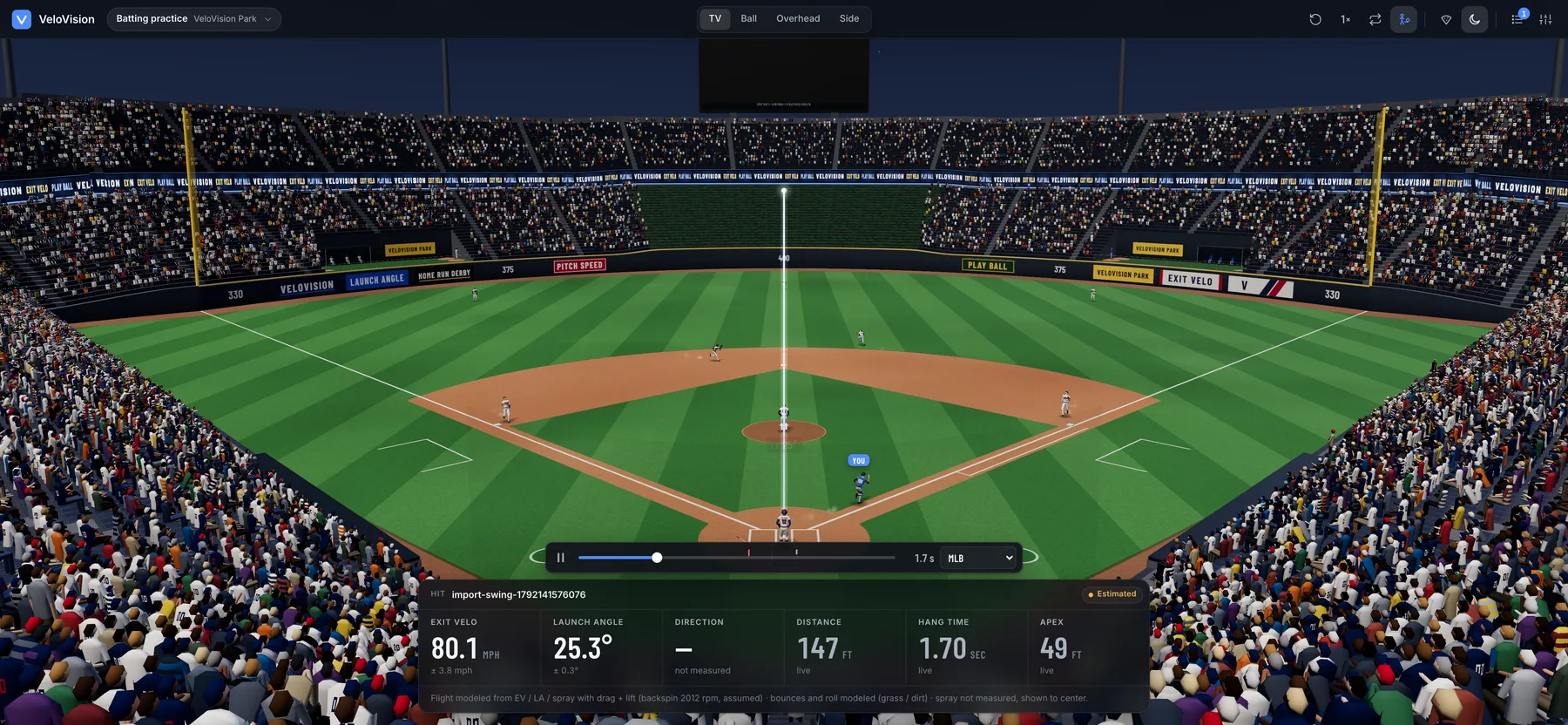
The app’s 3D stadium replaying a swing in batting practice from the TV camera: a fly ball climbing toward centre field over a full ballpark, with a readout of exit velocity 80.1 mph ± 3.8 and launch angle 25.3 degrees while distance and hang time count up
Replay a swing in the stadiumThe hit flies out in VeloVision Park, with its numbers underneath.
VeloVision settings: Spin from the seams (Experimental) switched on, with its explanation: it reads the ball’s spin from how its seams turn in the first frames after release, shows in a Spin card and never changes the pitch speed; computer-made clips only so far, not yet checked against a spin-measuring device
A switch for Experimental spinOff if you prefer. It never changes the pitch speed.
VeloVision home screen: Film a pitch, last pitch 75.0 mph ± 1.0, Film a swing, last swing 80.1 mph, 25 degrees, 292 feet
Film a pitch or a swingLast pitch and last swing, up front.
VeloVision settings, Data and Privacy: 7 pitches saved, 2 swings saved, a Delete all pitches, swings and clips button, and the note that clips and results stay on this phone, no account, nothing is sent
Stays on your phoneClips and results stay on the phone. No account; nothing is sent.

Features

Questions

SetupWhere does the phone go?

For a pitch: on a tripod 5–7 ft behind the pitcher’s rubber, about 6 ft toward the glove side, 4–5 ft high, phone sideways, 1x lens, aimed at the net. For a swing: on a tripod beside the hitter, 12–20 ft away, waist or chest high. The app has a setup guide for each.

DistanceDo I have to measure anything?

No. Without the lens-to-net distance you still get a speed, labeled Estimate, with a wider ±. Enter the distance in the app’s setup and the speed is more reliable.

CertaintyHow sure is the speed?

Every speed carries its uncertainty, like 75.0 mph ± 1.0. When VeloVision can’t measure reliably it says No speed and why. It refuses rather than guess. The numbers on this page are what the app shows for computer-made test clips; there is no real-world accuracy claim yet.

PrivacyWhere do my clips go?

Analysis runs on the phone. On Free, clips and results stay on the phone and there is no account to make. With Pro you can turn on the Cloud library: your clips back up to your own private library, signed in with Apple, so you can watch them without keeping them on the phone.

ExperimentalWhat about spin and hitting?

All are in the app and all are marked Experimental: movement, spin read from the seams, release and arrival angles, and for a swing the exit velocity, launch angle and distance. They have only been run on computer-made test clips so far.

LaunchWhen can I get it?

VeloVision is in development for iPhone 16e and similar, and has not been released. There is no App Store link yet. Send one email and you will hear when it launches.

A worn, scuffed baseball with tan seams in front of a blue sky

Hear when it launches

VeloVision is in development and has no App Store link yet. One email and you are on the list.

Get notified when it launches